


About company
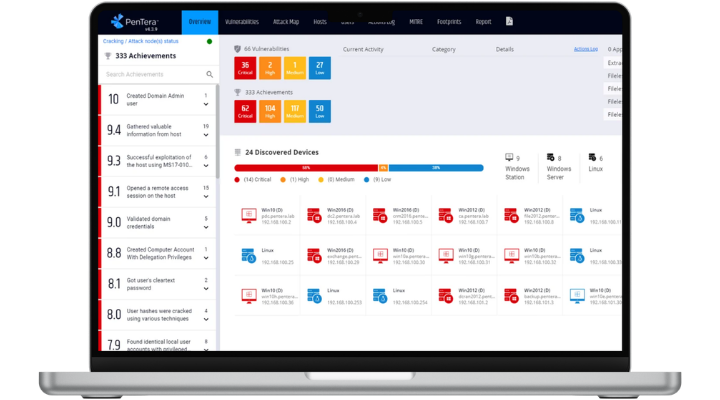
Pentera is an automated security validation platform that safely replicates the techniques of real attackers in your production infrastructure and shows which vulnerabilities are actually exploitable and how far an attacker can get toward critical assets. Softprom has been the official distributor of Pentera since October 2026 in 25 countries: Armenia, Austria, Azerbaijan, Bulgaria, Croatia, Cyprus, Czech Republic, Estonia, Georgia, Germany, Greece, Hungary, Kazakhstan, Kyrgyzstan, Latvia, Lithuania, Moldova, Poland, Romania, Slovakia, Slovenia, Tajikistan, Turkmenistan, Ukraine, and Uzbekistan.
The platform is used by 1200+ enterprises in 60+ countries. In 2025 Pentera became the first company in the Adversarial Exposure Validation category to surpass $100 million in annual recurring revenue and the first to achieve ISO/IEC 42001 certification for AI-based systems. Softprom is a value-added IT distributor since 1999: 30+ certified cybersecurity engineers run Pentera demonstrations and pilots for customers and partners across the region.
What Are You Trying to Solve?
We pentest once a year, but the infrastructure changes every week
Pentera Core: automated internal penetration testing on demand or on a schedule — the full kill chain from initial access to a domain admin account.
The scanner shows thousands of CVEs, but it is unclear where to put people
Pentera Core + Resolve: prioritization by proven exploitability, not by CVSS. Only vulnerabilities with a confirmed attack path go into the work queue.
We don't know what an attacker sees from the outside
Pentera Surface: testing of the external perimeter, web applications, and APIs with real attacks, including exposed identities.
We moved to the cloud — do the same security controls work there?
Pentera Cloud: testing of cloud and hybrid environments against attacks through compromised identities and misconfigurations.
The auditor demands evidence of testing: NIS2, DORA, PCI DSS v4.0, ISO/IEC 27001
Pentera reports with evidence for every step of the attack. The platform supports evidence workflows for these standards but does not certify compliance.
Will we withstand ransomware?
RansomwareReady Module: safe emulation of ransomware campaign scenarios in your network, showing where the attack chain stops — and where it does not.
What Is Automated Security Validation
Automated Security Validation (ASV) is a category of solutions that not only find vulnerabilities but also safely exploit them in the real environment to prove which risk actually exists. Gartner describes this category as Adversarial Exposure Validation (AEV), a component of the Continuous Threat Exposure Management (CTEM) practice.
The difference from a classic vulnerability scanner: the scanner shows where a problem may exist; Pentera shows whether an attacker can actually use it and how far they get next. The difference from Breach & Attack Simulation: BAS checks whether security controls respond to known scenarios; Pentera runs a real attack without predefined scenarios — from reconnaissance to lateral movement and privilege escalation.
Controlled execution
Attack throttling, impact limits, and an emergency stop during testing in production.
Read-only where required
For sensitive systems the attack is limited to read-only mode.
Audit log of every step
A complete record of the platform's actions — evidence for security teams and auditors.
No data retention
Customer data is never used for model training and is not retained by Pentera.
Pentera Solutions and Product Lines
Pentera Core
Internal network security validation: full attack chains, control bypass, lateral movement, and privilege escalation toward critical assets.
Internal network
Pentera Surface
External perimeter validation: real attacks on web applications, internet-facing systems, and exposed identities; AI-based web application testing with adaptive payload generation.
External perimeter
Pentera Cloud
Cloud identity and hybrid environment validation: cloud-native attacks through compromised accounts and misconfigurations.
Cloud and hybrid
Pentera Resolve
Remediation orchestration: consolidates findings, adds context, triggers prioritized fixes through 100+ native integrations, and re-tests every closed vulnerability.
Remediation and re-validation
Credential Exposure Module
Detection of leaked credentials — names, passwords, addresses — and verification of whether they grant real access to your infrastructure.
Add-on module
RansomwareReady Module
Validation of the organization's readiness for ransomware campaigns: safe emulation of ransomware scenarios in your network.
Add-on module for Pentera Core
Pentera services complement the platform: SECTOR11 Adversarial Testing — expert-led red teaming, including for AI model interfaces, applications, and integrations; Security Validation Advisory — building a security validation program in the organization.
What Softprom Provides
For Partners: Resellers, Integrators, MSPs
- Deal registration: Pentera deal registration through the partner portal with additional margin for the partner leading the customer.
- Pre-sales and demos: 30+ certified Softprom cybersecurity engineers — no need for your own Pentera engineer at the start.
- Demo instance: A Pentera environment for demonstrations and customer pilots.
- Local contracts: Payment in local currencies through 14 Softprom regional offices.
- Training: Access to Pentera partner courses and vendor marketing materials.
For Customers: CISOs, SOC Leaders, Red Teams, Vulnerability Management
- Pilot in your network: A safe launch in production; scope, limits, and date are agreed with a Softprom engineer.
- Architecture consulting: Which segments, assets, and scenarios to include in Pentera validation first.
- Local team: An engineer and a manager in your country; support in English, Ukrainian, Russian, German, and Polish.
- Audit: Help with the evidence package for NIS2, DORA, ISO/IEC 27001, and PCI DSS v4.0.
Where to Buy Pentera
Softprom is the official distributor of Pentera in 25 countries: Armenia, Austria, Azerbaijan, Bulgaria, Croatia, Cyprus, Czech Republic, Estonia, Georgia, Germany, Greece, Hungary, Kazakhstan, Kyrgyzstan, Latvia, Lithuania, Moldova, Poland, Romania, Slovakia, Slovenia, Tajikistan, Turkmenistan, Ukraine, and Uzbekistan. Softprom regional offices operate in Vienna, Kyiv, Almaty, Baku, Tbilisi, Tashkent, Chișinău, Yerevan, Warsaw, Prague, Sofia, Budapest, and Bucharest. Pentera licenses are supplied through authorized Softprom partners in each country; request a consultation or a pilot via the form on the website.
Frequently Asked Questions
A scanner finds potential vulnerabilities and rates them by CVSS. Automated penetration testing safely exploits them in the real environment and shows the full attack path to critical assets — so the remediation list is shorter and proven.
Yes, if your infrastructure changes more often than once a year. A manual pentest is a snapshot on a date; an automated one runs weekly or after every change and checks whether new attack paths have appeared.
Yes. The platform works with attack throttling, impact limits, an emergency stop, and read-only modes; every step is recorded in the audit log. Pentera does not retain customer data and does not use it for model training.
No. BAS checks how security controls react to known scenarios. Pentera runs a real attack without predefined scenarios — from reconnaissance to privilege escalation — and proves exploitability in your environment.
In 25 countries: Armenia, Austria, Azerbaijan, Bulgaria, Croatia, Cyprus, Czech Republic, Estonia, Georgia, Germany, Greece, Hungary, Kazakhstan, Kyrgyzstan, Latvia, Lithuania, Moldova, Poland, Romania, Slovakia, Slovenia, Tajikistan, Turkmenistan, Ukraine, and Uzbekistan.
Reports provide evidence for NIS2, DORA, PCI DSS v4.0, ISO/IEC 27001, SOC 2, NIST CSF, GDPR, and CIS Controls. Pentera does not certify compliance — it provides validated test results for auditors.
Submit a request via the consultation form — a Softprom engineer will agree the scope, limits, and launch date in your network.
Softprom is the official distributor of Pentera across Central and Eastern Europe, the Caucasus, and Central Asia. Request a Pentera demonstration or pilot in your infrastructure via the consultation form.
Countries
Softprom is the official distributor of this vendor in the territory of
 Armenia
 Austria
 Azerbaijan
 Bulgaria
 Croatia
 Cyprus
 Czech Republic
 Estonia
 Georgia
 Germany
 Greece
 Hungary
 Kazakhstan
 Kyrgyzstan
 Latvia
 Lithuania
 Moldova
 Poland
 Romania
 Serbia
 Slovakia
 Slovenia
 Tajikistan
 Turkey
 Turkmenistan
 Ukraine
 Uzbekistan