


How to Effectively Prioritize Host Incident Investigations: A Practical Guide with GREYCORTEX
News | 13.11.2026
Modern Security Operations Centers (SOC) face thousands of daily alerts from firewalls, EDR agents, intrusion detection systems, and SIEM platforms. As the attack surface continues to expand, attempting to manually verify every notification leads to Alert Fatigue — analyst burnout, slower response times, and missed targeted attacks.
To strengthen infrastructure protection, cybersecurity teams need to shift their focus from analyzing isolated events to comprehensively assessing the state of specific network nodes. The NDR (Network Detection and Response) platform GREYCORTEX Mendel automates network telemetry collection and helps specialists accurately determine which hosts require immediate investigation first.
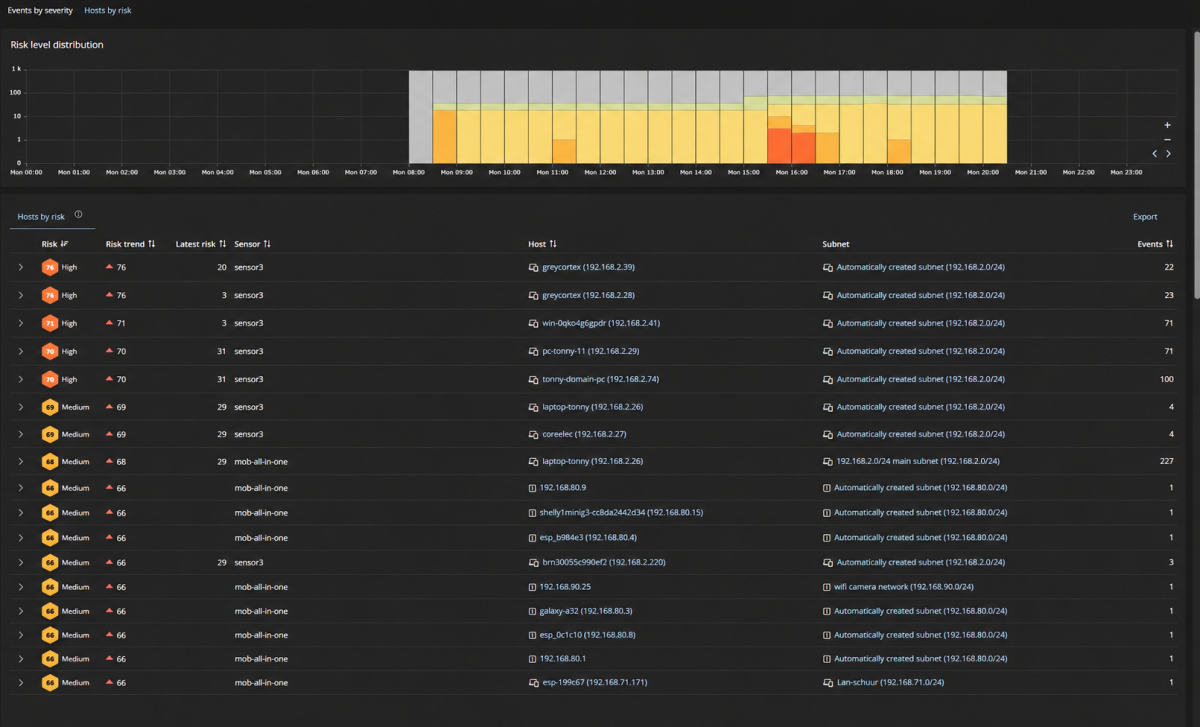
Why the traditional approach to alert handling overloads the SOC
The classic analyst workflow revolves around an event queue: the system generates a warning when a specific signature or rule is triggered, and a specialist picks it up for review. In practice, this approach has several critical limitations:
- Lack of attack context: A single event (such as an unusual DNS query or port scan) may appear to be a minor anomaly, even though it is actually part of a multi-stage host compromise.
- High volume of false positives: Static rules do not account for the specifics of a particular infrastructure, legitimate administrator activity, or the behavior of business applications.
- Fragmented data: Events related to the same computer or server are scattered across dozens of separate tickets, forcing analysts to spend hours manually correlating logs.
- Increased attacker dwell time: While specialists investigate low-priority incidents, attackers have enough time to establish persistence in the network, escalate privileges, and initiate lateral movement.
Shifting to a Host-Centric approach solves this challenge: the system consolidates all anomalies, behavioral deviations, and rule triggers around a specific network asset, creating a unified picture of the threat.
Five key factors for prioritizing hosts in a corporate network
To allocate security team resources effectively, every suspicious node must be evaluated across a combination of technical and business parameters. In GREYCORTEX Mendel, prioritization is built on five core criteria.
1. Aggregate host risk score
Instead of forcing engineers to examine dozens of disconnected warnings, the system calculates a dynamic Risk Score for every device. If a single host exhibits password brute-force attempts, communication with a suspicious external domain, and an abnormal volume of outbound SMB traffic, their combined weight automatically pushes that node to the top of the investigation queue.
2. Asset criticality and its role in business processes
An incident on a guest smartphone connected to corporate Wi-Fi and similar activity on an Active Directory domain controller carry vastly different risks for the business. GREYCORTEX Mendel automatically discovers and classifies all assets on the network (servers, workstations, network equipment, IoT, and industrial controllers), allowing teams to assign higher priority to mission-critical segments and databases.
3. Attack stage according to the MITRE ATT&CK framework
Understanding which stage of the lifecycle a threat has reached helps determine response urgency. Events indicating initial reconnaissance warrant attention, but activities aligned with tactics such as Credential Access, Lateral Movement, or Exfiltration signal immediate danger and require urgent host isolation.
4. Deviations from behavioral baselines
GREYCORTEX machine learning algorithms continuously analyze network traffic across layers L2–L7 and build an individual baseline of normal behavior for each host and group of similar devices. The system can distinguish a scheduled nightly server backup from an unusual archive upload originating from an accounting workstation outside business hours.
5. Correlation with Threat Intelligence and vulnerabilities
A host's priority rises sharply if communications with known command-and-control (C2) servers, malicious IP addresses, or phishing domains are detected, or if outdated cryptographic protocols and vulnerable software versions are in use. Enriching network metadata with up-to-date Threat Intelligence feeds enables analysts to immediately separate true compromises from random network glitches.
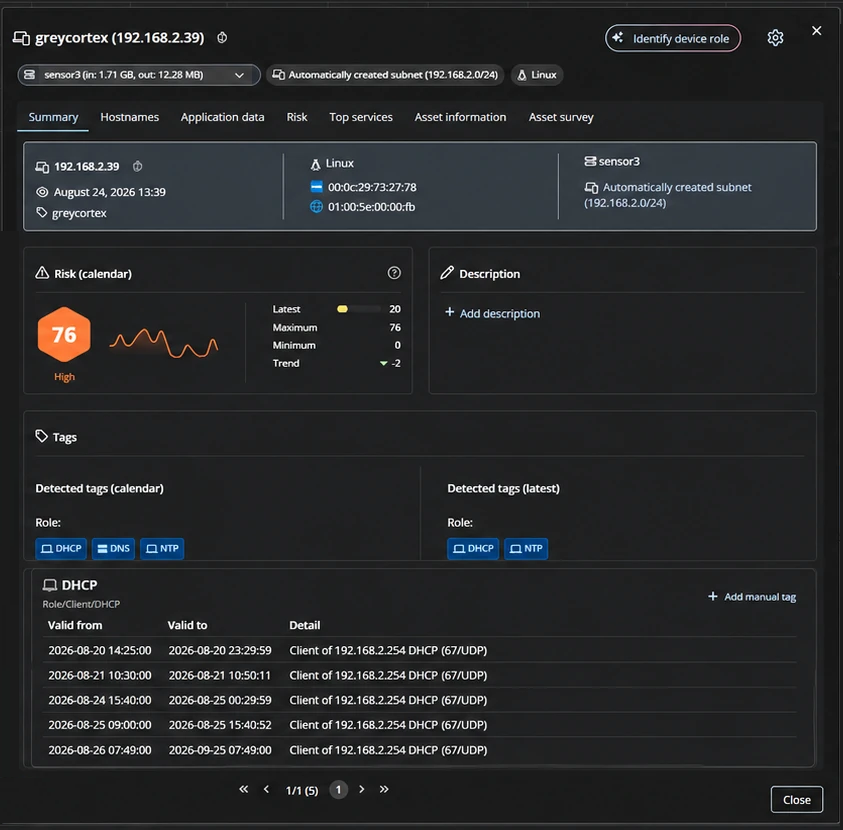
Comparison of incident investigation approaches
Below is a comparison between the traditional event-processing model and host-level prioritization powered by the GREYCORTEX Mendel NDR solution.
Manual review of individual alerts
- Analysis focus: Isolated events and individual signature triggers without overarching asset context.
- Triage speed: Low, as analysts must manually cross-reference IP addresses, timestamps, and logs from disparate systems.
- Risk of missing complex attacks: High, since low-priority anomalies are frequently ignored even when they form a single compromise chain.
- SOC team workload: Excessive due to a high volume of duplicate and false-positive alerts.
Host-based risk prioritization in GREYCORTEX Mendel
- Analysis focus: A specific network node with an aggregated history of all anomalies, connections, and attacker tactics.
- Triage speed: High due to automated event grouping, asset criticality scoring, and ready-to-use attack chain visualization.
- Risk of missing complex attacks: Minimal thanks to the correlation of behavioral factors, L7 inspection, and MITRE ATT&CK mapping.
- SOC team workload: Optimized, allowing engineers to focus exclusively on validated high-risk incidents.
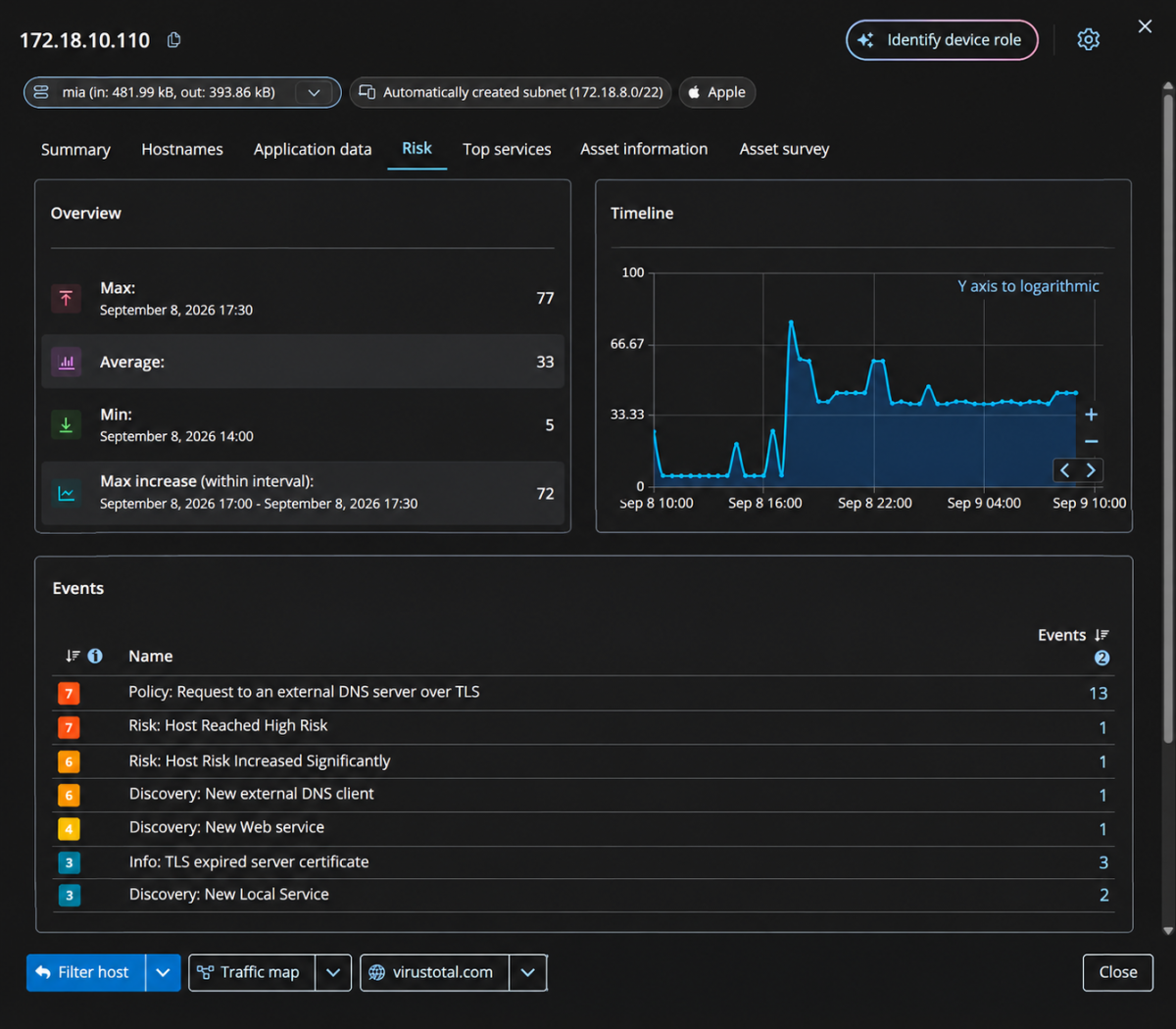
Step-by-step algorithm for investigating a suspicious host
Once the system elevates a specific node to the top of the priority list, security specialists can follow a structured workflow that reduces investigation time from several hours to just a few minutes:
- Host identification and context verification: The analyst opens the device profile and immediately sees its IP and MAC addresses, hostname, active user account, operating system, VLAN assignment, and designated business criticality level.
- Anomaly timeline analysis: The timeline displays the chronological sequence of all suspicious actions — from the initial intrusion vector to lateral spread attempts within the perimeter — making the scope of the incident immediately clear.
- Network communication and metadata inspection: Using an interactive communication graph, the engineer checks which internal servers and external resources the node interacted with, which protocols were used (DNS, HTTP/S, SMB, RDP, Kerberos), and how much data was transferred. If needed, the specialist can immediately download the relevant traffic capture in PCAP format for deep forensic analysis.
- Containment and automated response: After confirming a compromise, the security team sends the indicators to SIEM, SOAR, EDR, or a firewall via built-in API integrations to instantly isolate the infected host and block malicious activity.
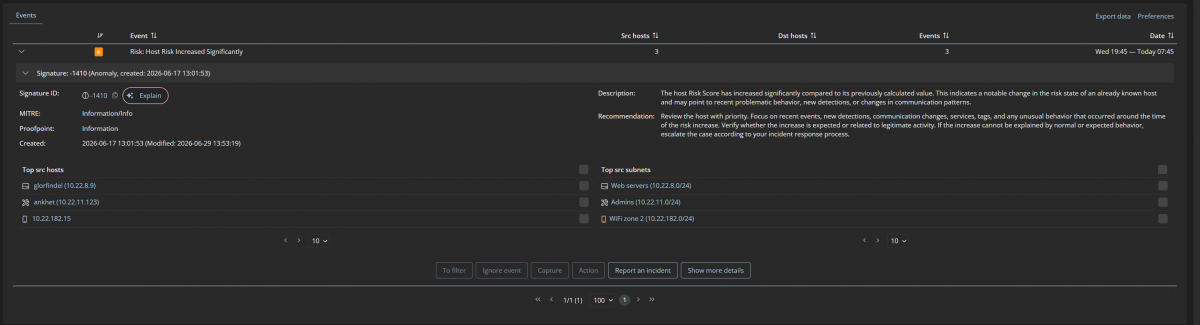
Effective defense begins not with adding more detection rules, but with the ability to pinpoint among thousands of signals the three hosts whose compromise could halt the business today.
Strategic benefits for CISOs and security leaders
Implementing host-based investigation prioritization with GREYCORTEX delivers measurable value not only to technical teams, but also to executive leadership:
- Reduction of key MTTD and MTTR metrics: Automated threat correlation at the host level enables teams to detect and neutralize incidents early, before financial and reputational damage occurs.
- Scaling SOC efficiency without expanding headcount: The platform automates routine initial triage, enabling existing teams to handle significantly larger volumes of network traffic.
- Complete visibility into infrastructure blind spots: Because NDR analyzes a copy of network traffic (SPAN/TAP), the system monitors even devices where EDR agents cannot be installed (legacy OS servers, IoT devices, access control systems, and OT environments).
- Regulatory compliance: Detailed logging of network interactions and a transparent incident management workflow streamline audits for ISO 27001, NIS2, and local cybersecurity regulations.
Implementing GREYCORTEX solutions with Softprom support
Softprom is an official distributor of GREYCORTEX with deep hands-on expertise in building network security and threat monitoring architectures for enterprise and public sector organizations.
Softprom engineers support customers and partners across every stage of the project lifecycle: from initial network architecture audits and sensor sizing to deploying a Proof of Concept (PoC) in live infrastructure, configuring integrations with existing security tools, and training SOC teams.
Want to see how host prioritization in GREYCORTEX Mendel can uncover hidden threats in your network? Contact Softprom experts to request a personal consultation or deploy a free pilot project of GREYCORTEX solutions in your infrastructure.
Share:


