


Gartner Magic Quadrant for Cloud-Native Application Platforms 2026: AWS and Google Named Leaders, Cloudflare a Challenger
News | 25.08.2026
Analysis of the Gartner Magic Quadrant for Cloud-Native Application Platforms, August 2026
Gartner has published the Magic Quadrant for Cloud-Native Application Platforms, August 2026, evaluating 12 technology providers across their ability to execute and completeness of vision. Amazon Web Services (AWS) and Google are positioned as Leaders, while Cloudflare is named a Challenger.
According to Gartner, cloud-native application platforms provide managed application runtime environments and integrated capabilities for managing application lifecycles in the cloud. These platforms are designed to simplify application deployment and operation by reducing the need for development teams to manage underlying infrastructure and containers.
The market is evolving beyond traditional application runtimes. Gartner highlights the growing importance of serverless computing, containerized workloads, AI inference and agentic AI capabilities, integration with databases and developer tools, governance, high availability and disaster recovery.
Gartner Magic Quadrant: AWS, Google and Cloudflare
The 2026 Magic Quadrant evaluates 12 providers. Gartner positions the vendors in four categories:
- Leaders: Alibaba Cloud, Amazon Web Services, Google, Microsoft and Red Hat
- Challengers: Cloudflare and Oracle
- Visionaries: Vercel
- Niche Players: Netlify, Render, Tencent Cloud and Upsun
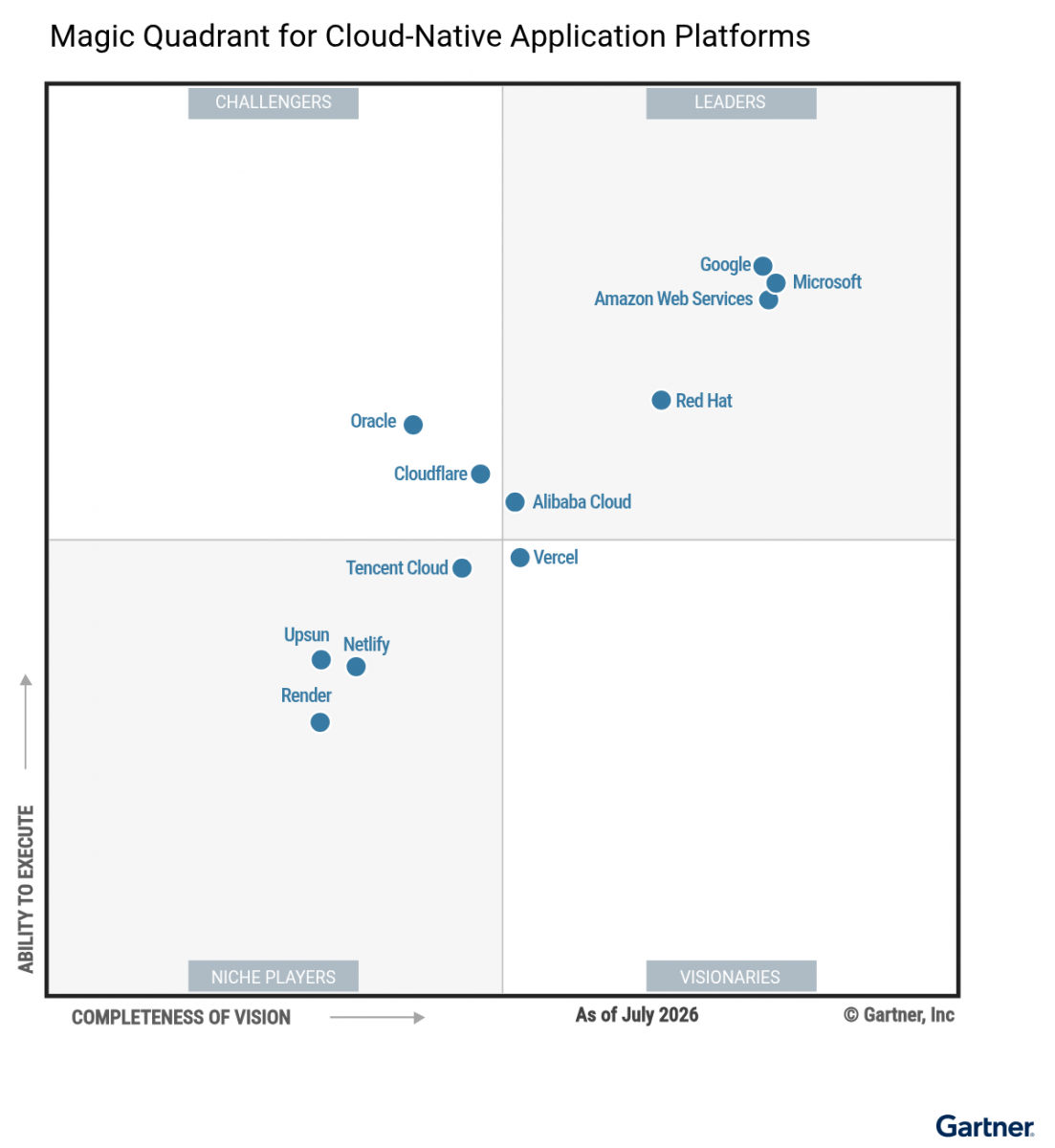
Source: Gartner, Magic Quadrant for Cloud-Native Application Platforms, 3 August 2026.
Key Trends in Cloud-Native Application Platforms
Gartner notes that cloud-native application platforms are increasingly becoming integrated environments that combine infrastructure abstraction, standardized runtimes, governance guardrails and operational controls.
For software engineering teams, the key capabilities evaluated in the report include:
- Cloud-native runtimes: Managed environments for deploying and running modern applications without directly managing underlying infrastructure.
- Serverless and containers: Support for serverless functions and containerized workloads on abstracted infrastructure.
- AI and agentic workloads: Capabilities for AI inference, AI application development and agentic AI frameworks.
- Developer experience: Tools and services that enable teams to build, deploy and operate applications with less infrastructure expertise.
- Governance and operations: Monitoring, observability, cost management, platform engineering and operational controls.
- High availability: Automated failover, backup and disaster recovery capabilities for business-critical applications.
Gartner also points to the growing importance of multiplatform strategies. Organizations can combine comprehensive cloud platforms with more specialized solutions to leverage different strengths across application architectures.
Analysis of Vendor Solutions
Amazon Web Services (AWS)
Position: Leader
Amazon Web Services is positioned as a Leader in the Gartner Magic Quadrant for Cloud-Native Application Platforms. AWS provides a broad platform covering serverless functions with AWS Lambda, serverless containers with AWS Fargate, managed application deployment with AWS Elastic Beanstalk and a growing set of AI capabilities.
Gartner highlights recent AWS innovations including Lambda Managed Instances for steady-state workloads and Lambda Durable Functions for resilient, stateful orchestration. AWS has also expanded its generative and agentic AI capabilities through agentic developer tooling, Amazon Bedrock AgentCore and AI-driven observability in Amazon CloudWatch.
According to Gartner, AWS's key strengths include the breadth of its portfolio across infrastructure, platform and AI layers, support for mission-critical workloads and enterprise-grade operational capabilities. AWS services are designed to support highly scalable and fault-tolerant applications across serverless, container and AI environments.
Gartner also notes that the breadth and granularity of the AWS portfolio can increase evaluation and governance complexity for some customers. Organizations may require architecture guidance to manage service dependencies, cost visibility and consistent platform adoption at scale.
For organizations looking to modernize applications or build AI-enabled cloud-native workloads, AWS provides a broad foundation covering infrastructure, application platforms and AI services.
Position: Leader
Google is positioned as a Leader in the Gartner Magic Quadrant. Its offering includes Google Cloud services such as Cloud Run, Firebase and Gemini Enterprise Agent Platform, providing serverless, containerized and agentic deployment options.
Gartner also highlights Application Design Center, which helps teams design, standardize and deploy template-driven applications on Google Cloud. The platform combines developer-oriented services with capabilities for application modernization and AI-enabled development.
Among Google's strengths, Gartner highlights its open-source-first strategy and alignment with widely adopted technologies including Kubernetes, TensorFlow and Knative. The report also points to Google's partner-led ecosystem and flexible pricing models, including consumption-based, subscription-based and outcome-based approaches.
Google's fully managed services, including Cloud Run and Firebase, can help developers and enterprises experiment with and adopt cloud services quickly, supporting rapid prototyping and incremental application development.
At the same time, Gartner notes that the breadth of Google's cloud-native and AI capabilities can make the portfolio more difficult for buyers to navigate. Customers may need guidance in determining how Cloud Run, Firebase, Gemini Enterprise Agent Platform and Google AI Studio fit together for different application and AI development scenarios.
Cloudflare
Position: Challenger
Cloudflare is positioned as a Challenger in the Gartner Magic Quadrant for Cloud-Native Application Platforms. In 2026, Cloudflare expanded its Workers platform beyond lightweight edge functions with Cloudflare Containers and the Agents SDK.
Cloudflare Containers support more resource-intensive workloads, custom runtimes and existing container images, while the Agents SDK introduces capabilities for stateful AI agents. Cloudflare has also introduced CPU-time billing designed to charge for active CPU cycles rather than idle time while agents wait for large language model responses.
Gartner additionally highlights Cloudflare R2, which eliminates data egress costs, and the Cloudflare Data Localization Suite, addressing requirements around data sovereignty and distributed application architectures.
Among Cloudflare's strengths, Gartner highlights its unified Connectivity Cloud architecture, global network and positioning as a neutral multicloud overlay. This approach can help organizations deliver applications, security and edge workloads consistently across heterogeneous cloud environments.
Gartner also notes that Cloudflare may be less suitable for complex enterprise architectures requiring deep back-end control, traditional application migration paths or highly customized runtime topologies. Organizations should therefore validate observability, debugging and operational-control requirements for complex modernization projects.
What the Gartner Magic Quadrant Means for Cloud-Native Application Strategy
The Gartner analysis illustrates the increasing convergence of cloud application platforms, serverless computing, containers and AI. Modern platforms are expected not only to run applications but also to support AI inference, agentic workloads, developer automation, governance and operational management.
The positioning of AWS and Google as Leaders reflects the breadth of their cloud-native application capabilities and ability to address diverse enterprise requirements. Cloudflare's Challenger position highlights a different approach focused on a globally distributed architecture, edge execution, security and a multicloud application layer.
For enterprises, the optimal platform depends on application architecture, AI requirements, infrastructure strategy, operational model, data residency requirements and the level of control required over the underlying environment. A structured architecture assessment can help identify which platform or combination of platforms best fits a particular workload.
Build Your Cloud-Native and AI Application Strategy with Softprom
Softprom works with leading cloud and technology providers to help organizations evaluate, design and implement cloud-native application architectures.
Our expertise covers cloud migration, application modernization, AI workloads, serverless and container platforms, multicloud architectures and the integration of cloud-native technologies into existing IT environments.
Frequently Asked Questions
Gartner defines cloud-native application platforms as managed application runtime environments with integrated capabilities for managing application lifecycles in the cloud. They enable application deployment and operation without requiring development teams to provision infrastructure or manage containers directly.
Modern cloud-native platforms increasingly support AI inference, AI application development and agentic AI workloads. This enables development teams to build and deploy AI-enabled applications using managed cloud infrastructure and integrated platform services.
AWS and Google are positioned as Leaders and provide broad cloud-native application platforms covering infrastructure, serverless, containers, application development and AI capabilities. Cloudflare is positioned as a Challenger and focuses on a globally distributed platform combining edge execution, security, connectivity and increasingly containerized and agentic application workloads.
The choice should be based on application requirements, deployment model, AI and agentic workloads, scalability, governance, operational control, data residency and existing infrastructure. For some organizations, a multiplatform strategy can combine the strengths of different cloud-native platforms.
Source: Gartner, Magic Quadrant for Cloud-Native Application Platforms, Mukul Saha, Alex Coqueiro and others, 3 August 2026. Gartner's research evaluates 12 providers based on Ability to Execute and Completeness of Vision.
GARTNER is a registered trademark and service mark, and MAGIC QUADRANT is a registered trademark of Gartner, Inc. and/or its affiliates in the U.S. and internationally and are used herein with permission. All rights reserved.
Share:


