


SPARK Matrix Report: Key Trends and Market Leaders in DDoS Protection in 2026
News | 27.08.2026
The modern cyber threat landscape requires organizations to transition from simple volumetric traffic filtering to a comprehensive, multi-layered response. The QKS Group SPARK Matrix™ report for Q3 2026 confirms that AI-driven autonomy and multi-layered behavioral analysis have become key factors in effective DDoS mitigation.
Key DDoS mitigation trends in 2026
AI-driven autonomous attack mitigation
- Minimal response time: Machine learning-powered systems generate signatures and block threats within seconds without SOC operator intervention.
- Detection accuracy: Behavioral analysis reduces false-positive rates to near zero.
Layer 7 encrypted traffic protection without decryption
- HTTPS floods: The growing volume of application-layer attacks demands mitigation without exposing SSL/TLS certificates or requiring decryption.
- Behavioral fingerprinting: Analyzing TLS handshake patterns enables anomaly blocking while preserving data privacy.
Defending against pulse attacks and carpet bombing
- Carpet bombing: Distributed low-volume attacks targeting large IP address ranges are neutralized using adaptive per-prefix detection models.
- Pulse attacks: Mitigated through always-on inline monitoring that eliminates activation delays.
Convergence of WAAP and DDoS platforms
- Unified defense perimeter: Combining volumetric DDoS protection, WAF, API security, and bot management into a single ecosystem.
- Reduced fragmentation: Streamlining security operations and reducing operational burden on IT and SOC teams.
Scrubbing capacity scale alone is no longer a key differentiator. Buyer focus has shifted toward high detection accuracy and sub-second response times.
Market leaders and key vendors in the Softprom portfolio
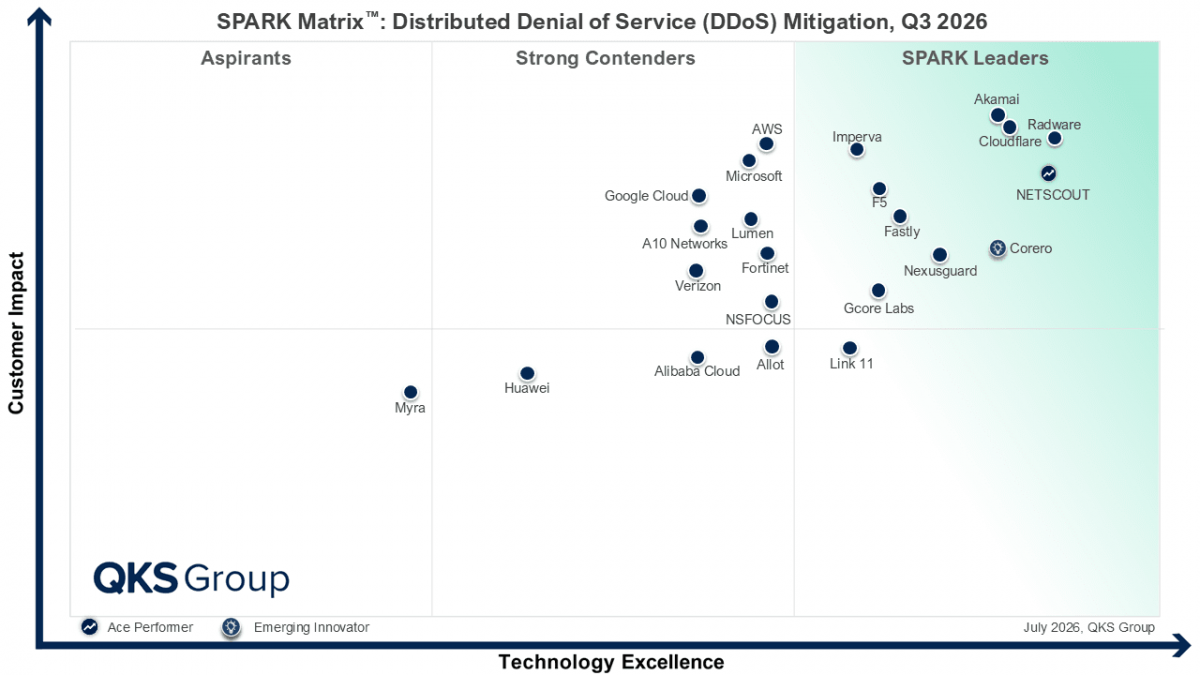
As an official distributor, Softprom offers solutions from the leaders of the SPARK Matrix™ report, providing full-cycle expertise and end-to-end support.
Imperva (Thales) — SPARK Leader
- Key advantages: Deep convergence of L3–L7 DDoS protection with WAF, API security, and bot management. Behavioral traffic analysis ensures high blocking precision.
- Target audience: Large enterprises, financial institutions, and online services with high application availability requirements.
Akamai — SPARK Leader
- Key advantages: Globally distributed Prolexic platform and edge filtering capabilities. Ability to absorb massive volumetric floods close to the attack source.
- Target audience: Global brands, media platforms, and e-commerce organizations with high network traffic volumes.
NETSCOUT — SPARK Leader
- Key advantages: Arbor platform with stateless packet processing architecture. ATLAS global threat intelligence and full "glass box" transparency of automated defense logic.
- Target audience: Telecom operators, ISPs, data centers, and government agencies requiring carrier-grade mitigation.
Cloudflare — SPARK Leader
- Key advantages: Rapid deployment, globally distributed edge network, Magic Transit for whole-network protection, and seamless Zero Trust integration.
- Target audience: Distributed enterprises and digital-native businesses seeking operational simplicity and a unified ecosystem approach.
AWS — Strong Contender
- Key advantages: Native AWS Shield Standard and enhanced Shield Advanced protections, seamless integration with CloudFront, Route 53, and other AWS services.
- Target audience: Organizations building infrastructure and applications primarily on Amazon Web Services.
Google Cloud — Strong Contender
- Key advantages: Google Cloud Armor with machine learning-based Adaptive Protection, scale of Google's global backbone network, and web application threat defense.
- Target audience: Cloud-native organizations and developers leveraging Google Cloud infrastructure.
Comparison of architectural protection models
Cloud and edge platforms (Akamai, Cloudflare, AWS, Google Cloud)
- Mitigation location: Distributed cloud network or edge nodes at the perimeter.
- Scalability: Virtually unlimited Tbps-scale absorption capacity.
- Deployment speed: Rapid onboarding via DNS changes, BGP steering, or proxy redirection.
Inline and hybrid solutions (NETSCOUT, Imperva)
- Mitigation location: On-premises appliances or hybrid pairing with cloud scrubbing.
- Control: Complete traffic path control and ultra-low latency enforcement.
- Use case: Infrastructure protection for carriers, data centers, and critical services.
Softprom is an official distributor of leading global cybersecurity vendors. Our experts will help you select the optimal solution for your architecture, conduct testing, and provide professional support at all stages of implementation. Contact us to request a consultation.
Share:


