


SIEM Systems in the 2026 Gartner Magic Quadrant: CrowdStrike, Google, Fortinet, and Rapid7
News | 27.11.2026
SIEM (security information and event management) is a class of platforms for threat detection, incident investigation, and response orchestration. In November, Gartner published its Magic Quadrant for Security Information and Event Management: the report evaluates vendors, four of which are represented in the Softprom portfolio — CrowdStrike, Fortinet, Google, and Rapid7. Softprom has been a value-added IT distributor since 1999, operating across Central and Eastern Europe, the Caucasus, and Central Asia; its cybersecurity division brings together 90+ vendors and 30+ certified engineers.
What is SIEM and How Gartner Evaluates This Market
SIEM collects and normalizes data from IT and OT environments, provides near-real-time monitoring and alerting, enriches events for investigation, and stores historical logs for auditing and reporting. The platform can be deployed as a service (SaaS), in the cloud, or on-premises.
Gartner positions vendors along two axes: Ability to Execute and Completeness of Vision. Based on these criteria, vendors are divided into four quadrants: Leaders, Challengers, Visionaries, and Niche Players. Positions are evaluated as of October 31, 2026.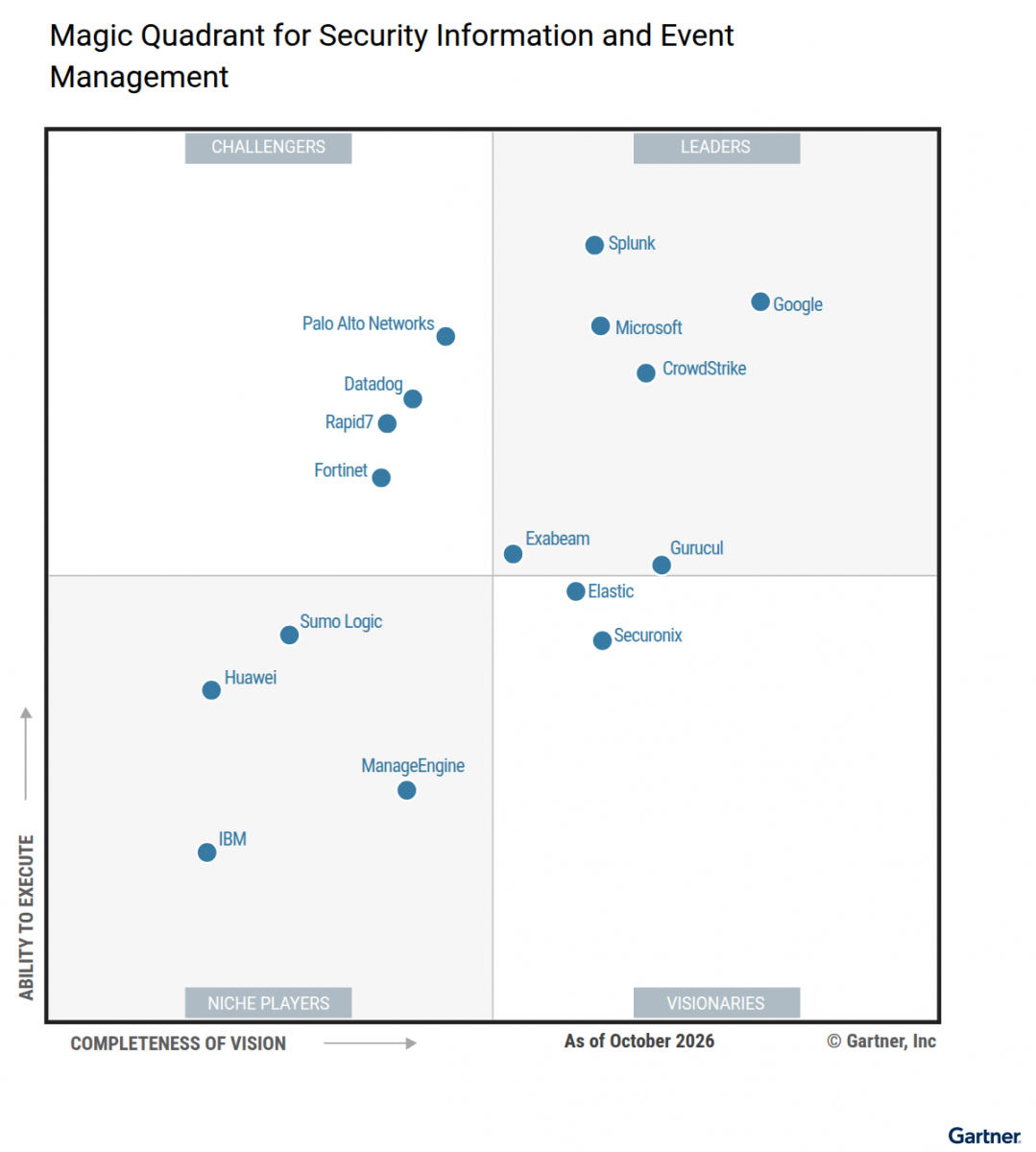
CrowdStrike — Leader: Falcon Next-Gen SIEM
Falcon Next-Gen SIEM is delivered primarily as SaaS. Licensing is calculated based on daily data ingestion volume (GB per day). Data from native CrowdStrike products, such as EDR, is ingested at no additional ingestion cost.
- Charlotte AI agents. A suite of agents and tools designed to accelerate analyst workflows. It includes a custom agent builder, with several AI capabilities included in standard licensing packages.
- Data pipeline management. Following the Onum integration, teams gain clear visibility into source health and ingestion costs, along with more granular control over data routing.
- Detection as code. Detection rules are developed and deployed via CI/CD pipelines, supported by an AI assistant.
Best fit for. Organizations already using the Falcon platform or planning to deploy CrowdStrike EDR.
Google — Leader: Google Security Operations
Google Security Operations (SecOps) operates exclusively as SaaS on Google Cloud. Licensing is available based on daily ingestion volume (GB per day) or per user for organizations with a large employee headcount.
- Gemini in SOC workflows. Includes an agent builder, an AI agent marketplace, and built-in AI features within the license. Teams have full visibility into AI operational status, confidence levels, and costs.
- Detection Engineering Agent. The agent validates detection coverage and generates new rules. Rules can be managed as code via CI/CD, backed by direct integration with Google Threat Intelligence.
- Data access governance. Over 300 prebuilt RBAC roles and multi-tenancy help large enterprises and MSSPs meet strict data sovereignty requirements.
Best fit for. Large enterprises and MSSPs requiring high-volume security analytics, particularly those already operating in Google Cloud.
Fortinet — Challenger: FortiSIEM
FortiSIEM is available in the cloud, on-premises, and as SaaS. The on-premises version is licensed by GB per day or by the number of devices, EPS, and agents. The SaaS version is licensed based on compute and storage tiers.
- Distributed storage. A ClickHouse cluster with regional shards allows organizations to keep data within specific jurisdictions while maintaining centralized analytics. It also supports federated search across Snowflake, Amazon Security Lake, and AWS S3, with archived data searchable without restoration.
- FortiAI and built-in SOAR. The platform supports natural language queries, alert clustering, and AI-assisted triage. An integrated low-code/no-code playbook builder reduces the need for a standalone SOAR platform.
- Built-in CMDB. An integrated asset and business service catalog helps prioritize incidents based on business risk.
Best fit for. Organizations with an existing Fortinet infrastructure and strict data residency requirements.
Rapid7 — Challenger: Incident Command
Incident Command runs on the SaaS-based Rapid7 Command Platform. Licensing is calculated based on the number of monitored assets, with unlimited data ingestion volume.
- AI-driven detection. The platform performs automated alert triage and guided investigations. UEBA, risk scoring, and insider intent detection provide visibility across a broad spectrum of threats.
- MDR integration. Rapid7’s Managed Detection and Response service is tightly integrated with the SIEM, allowing organizations to source monitoring and response from a single vendor.
- Integrations. The platform connects seamlessly to both internal and external data sources.
Best fit for. Small to large enterprises seeking predictable budgeting decoupled from log ingestion volume, as well as organizations considering MDR services.
What Matters to SIEM Buyers in 2026
According to Gartner’s observations, buyers focus primarily on three key factors when selecting a SIEM platform:
- Cost control. Effective data management, telemetry pipelines, and cost-efficient storage that does not compromise search performance are critical.
- Data sovereignty. Organizations need strict control over cross-border data movement through architecture, role-based access, and data ownership policies.
- Augmenting teams with AI. While interest continues to grow, Gartner notes that AI is not yet the primary driver behind SIEM purchasing decisions.
Softprom is an official distributor of CrowdStrike, Fortinet, and Rapid7, and a partner of Google. Softprom engineers will help you compare SIEM platforms tailored to your data sources, ingestion volumes, and storage requirements. Submit a request to get a consultation or a demo.
Frequently Asked Questions About the 2026 Gartner Magic Quadrant for SIEM
It is a platform that collects security events from various systems, detects threats, assists in incident investigation, and triggers response workflows. It also retains event history for compliance and auditing.
Share:


