


Gartner Magic Quadrant for Enterprise AI Assistants 2026: Google and OpenAI Named Leaders, AWS a Challenger
News | 18.09.2026
Analysis of the Gartner Magic Quadrant for Enterprise AI Assistants, September 2026.
Gartner has published its first Magic Quadrant for Enterprise AI Assistants, evaluating 10 vendors of enterprise AI assistants on their ability to execute and completeness of vision. Google and OpenAI are positioned as Leaders, Amazon Web Services (AWS) as a Challenger, and Superhuman as a Niche Player.
According to Gartner, an enterprise AI assistant (EAIA) is an AI-first application powered by one or more generative AI models that augments employees' capabilities through agentic RAG search, agentic tools, and enterprise-grade security. The EAIA is becoming the single "front door" for work: employees use it to create content, conduct research, analyze data, collaborate, and access AI agents.
Gartner predicts that by 2029 enterprise AI assistants will be a pervasive element of the digital employee experience, with knowledge workers spending more time in them than in any other application. Gartner estimates the EAIA market will grow from $17 billion in 2025 to $71 billion by 2030. At the same time, most organizations are already deploying two or more AI assistants, signaling a preference for a multivendor approach.
Gartner Magic Quadrant: Google, OpenAI, AWS and Superhuman
The inaugural Magic Quadrant for Enterprise AI Assistants evaluates 10 vendors, ranging from hyperscalers and productivity-suite incumbents to independent AI labs and specialist platforms. Gartner positions vendors in four categories:
- Leaders: Anthropic, Google, Microsoft and OpenAI
- Challengers: Amazon Web Services and Glean
- Visionaries: no vendors were positioned in this category
- Niche Players: ClickUp, ServiceNow, Superhuman and Zoom
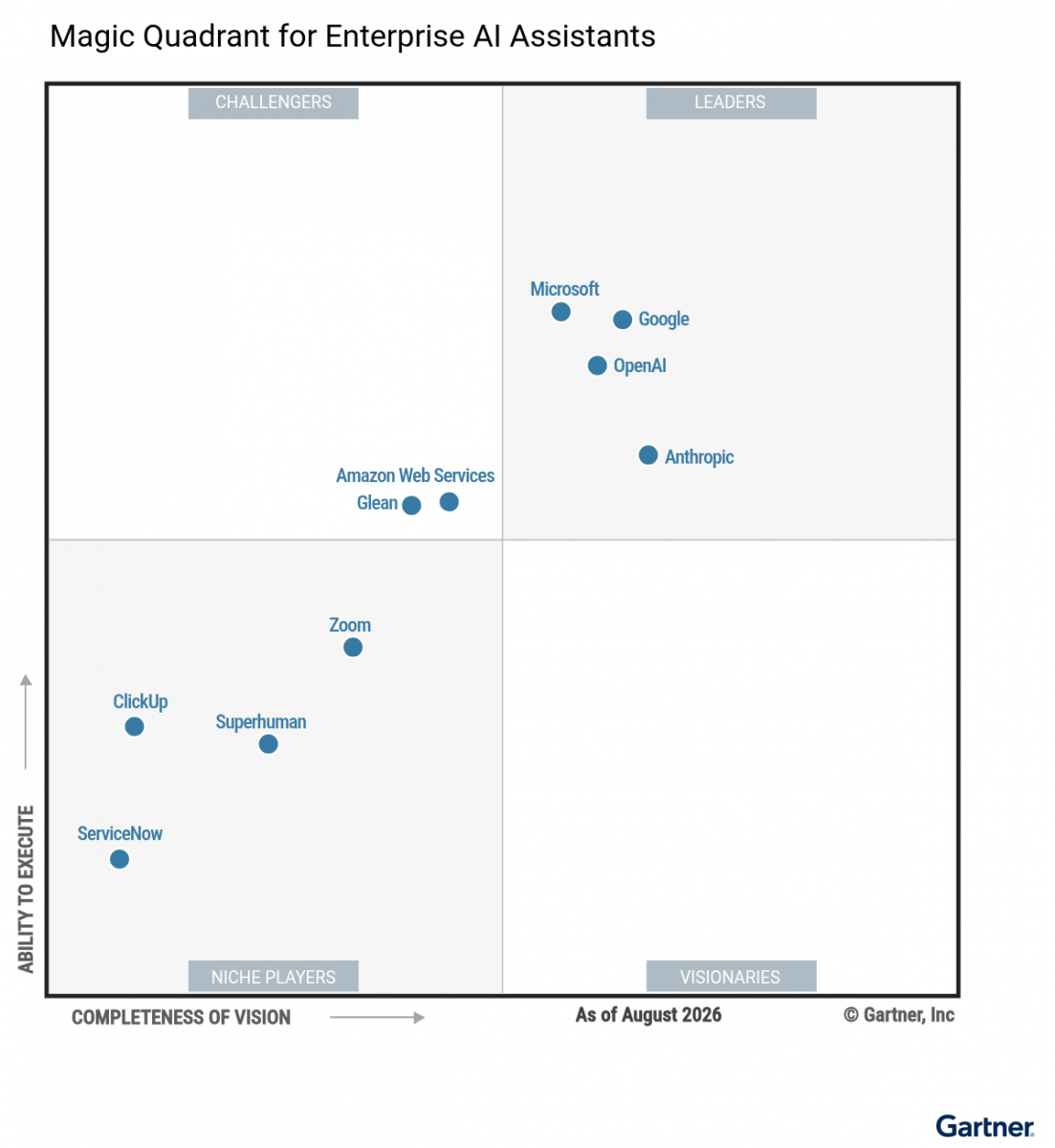
Source: Gartner, Magic Quadrant for Enterprise AI Assistants, September 2026.
Key trends in the enterprise AI assistant market
Gartner notes that the EAIA market is one of the youngest and, at the same time, one of the fastest-growing markets the firm has ever observed. Vendor differentiation is shifting from chat and retrieval toward agentic task execution. Key insights from the report for organizations selecting an AI assistant in 2026:
- Agentic shift: the center of gravity is moving from chat and information retrieval to long-running, multistep agents that take action across enterprise systems. Organizations need a clear view of which processes would benefit most from agentic orchestration and what connectors, MCPs, and actions each vendor offers.
- Platform versus best-of-breed: productivity-suite vendors (Microsoft, Google) bundle the assistant with platforms organizations may already own, while independents (Anthropic, OpenAI, Glean) offer a route that avoids deeper single-vendor lock-in. Weigh the consolidation benefits against overlap with capabilities already paid for and the lock-in it creates.
- Data residency, sovereignty and regional reach: regional hosting, sovereign and government-cloud options vary significantly, from the broad coverage of hyperscalers to U.S.-only hosting from several smaller vendors. For non-U.S. organizations and regulated industries, this can be decisive.
- Pricing and cost predictability: models range from per-user licenses to fully consumption-based billing of every interaction. Gartner recommends modeling realistic usage, insisting on cost transparency and setting departmental spending guardrails.
- Agent governance: most EAIAs include basic agent management, but advanced features often require additional licensing. Gartner expects growing competition between EAIA vendors and stand-alone AI agent management platforms.
- Model ownership: some vendors (Anthropic, Google, OpenAI and Amazon with Nova) own their frontier models, while others rely on third-party models. Organizations should confirm both the model strategy and the governance controls included in the price.
Gartner's recommendations for IT leaders include: start with governance, security and data access before a broad deployment; invest in change management, training and adoption measurement; be ready for a multi-vendor approach and pilot at least two EAIA tools; and work with finance and procurement teams to control consumption spend.
Vendor analysis
Position: Leader
Google is positioned as a Leader in the Gartner Magic Quadrant for Enterprise AI Assistants. Its EAIA, Gemini Enterprise (generally available since October 2025), unifies first-party agents, a no-code agent designer, enterprise chat and search, Google Workspace integration and third-party connectors. According to Gartner, Google's key differentiator is its end-to-end agent platform, backed by full-stack ownership of chips, models, infrastructure, and productivity applications.
Among Google's strengths, Gartner highlights Gemini Enterprise's positioning as a unified "AI front door" and its openness to Microsoft 365 data and other third-party sources, which extends the platform's relevance beyond the Google estate. The report notes a relatively simple pricing model: each user license contributes to an organization-wide quota, chat and search are included in the base SKU, and agent governance capabilities come at no additional cost. The vertical integration of chips, infrastructure, Gemini models and agents into a single offering may translate into cost and performance benefits for customers.
Gartner also notes that Gemini Enterprise delivers its richest collaboration experience alongside Google Workspace: users of other productivity suites may encounter gaps (for example, no native meeting summaries or office co-editing). In computer use agents and coworking functionality, Google trails slightly behind other Leaders, and the number of first-party vertical agents remains limited, although industry solutions are on the roadmap.
For organizations looking to bring enterprise search, an AI assistant and an agent platform together in a single governed environment, Gemini Enterprise provides a scalable foundation with a transparent cost model.
OpenAI
Position: Leader
OpenAI is positioned as a Leader in the Gartner Magic Quadrant. Its EAIA, ChatGPT Enterprise (generally available since August 2023), offers advanced reasoning, deep research, data analysis, enterprise search, connectors, and coworking agentic capabilities. OpenAI's differentiators are its leading frontier models combined with the agentic tools Codex and ChatGPT Work, and an enormous consumer user base that translates into enterprise pull.
Among its strengths, Gartner points to ChatGPT's brand familiarity and OpenAI's growing enterprise maturity, making it a compelling option for organizations that want a single AI-native platform without depending on multiple legacy products and licenses. OpenAI has rapidly built partnerships to scale enterprise deployments, including Microsoft and Amazon for cloud hosting and a broad network of system integrators. Codex is described as a market-leading agentic coding tool, and ChatGPT Work demonstrates the company's ability to drive market change. ChatGPT Enterprise combines research, search, memory, agents, and productivity connectors into one coherent system, offering an alternative for organizations wary of going all-in with a productivity suite vendor.
As a caution, Gartner notes that OpenAI's enterprise sales and go-to-market remain smaller than the hyperscalers', and organizations seeking high-touch account support may find it more limited. Its connector strategy is focused on productivity solutions, with less support for enterprise applications such as SAP, Workday, and ServiceNow, and industry-specific tailoring is limited. Gaps remain in security and governance, including limited DLP, advanced agent governance, and runtime controls, which regulated organizations will likely need to close via the compliance API and third-party tools.
Amazon Web Services (AWS)
Position: Challenger
Amazon Web Services is positioned as a Challenger in the Gartner Magic Quadrant for Enterprise AI Assistants. Its EAIA, Amazon Quick (generally available since October 2025), evolved from Amazon QuickSight and Amazon Q Business. Its differentiators include an aggregated activity feed, strong application connectivity (particularly within the AWS cloud), agentic orchestration, and personal and enterprise knowledge graphs. AWS targets large enterprises in manufacturing, IT, banking, healthcare, and energy with heterogeneous technology environments and an existing AWS footprint.
Among its strengths, Gartner highlights product breadth: Quick brings together AI chat, enterprise search, deep research, workflow automation, business intelligence, agent orchestration, and no-code app building in one platform, one of the broadest functional footprints in the market. Quick provides access to a wide range of frontier models, including Anthropic and OpenAI models via Amazon Bedrock, which enables additional data residency and processing assurances, and uses cost-effective Amazon Nova models for lower-complexity workloads. Organizations with existing AWS investments benefit particularly from native integrations with AWS services, including Amazon S3 and Databricks.
Gartner also notes that as a newer entrant in the EAIA market, Quick has lower brand recognition than the Leaders, which could slow adoption and require additional change management. Collaboration and co-authoring capabilities (Spaces, shared agents) are still developing. AWS must prove that capabilities inherited from multiple products translate into a coherent user experience, given that Amazon has less experience selling and supporting end-user productivity solutions than some competitors.
Superhuman
Position: Niche Player
Superhuman (formerly Grammarly) is positioned as a Niche Player in the Gartner Magic Quadrant. Its EAIA, Superhuman Go, reached general availability in October 2025. Following its rebrand, the company combined Grammarly, Coda, Superhuman Mail, and the Superhuman Go assistant under one platform. Superhuman Go differentiates as an in-line, proactive assistant that works across web and desktop surfaces via browser extensions and application integrations, meeting users where they are rather than requiring a separate application.
Among its strengths, Gartner notes product reach: the browser-centric approach integrates the AI assistant into the applications and workflows employees already use, reducing context switching and potentially driving higher adoption than EAIAs with a stand-alone interface. Superhuman Go uses contextual in-line triggers to provide feedback, corrections, and suggestions during content creation, rather than relying solely on user-initiated prompting. The company emphasizes extensibility through agent-building capabilities, native and custom integrations, and dedicated support for core connectors, serving as a common layer across enterprise applications and data sources.
Gartner also cautions that Superhuman's governance, administration, and cost management controls are weaker than competitors' (including lack of DLP, agent life cycle management, and granular group-based cost controls). Sales rely heavily on self-service channels, and large organization-wide rollouts are less common. The product is hosted on AWS with no regional hosting beyond North America, so organizations outside the U.S. should carefully verify data residency, processing, and compliance requirements.
What the Gartner Magic Quadrant means for your AI assistant strategy
Gartner's first report in this category marks the emergence of a new class of enterprise software: the AI assistant is evolving from a "smart chat" into an agentic front door for work, through which employees research, create, and delegate tasks. Agentic execution becomes the primary axis of differentiation, i.e., the assistant's ability to orchestrate multistep tasks and take auditable action across the right enterprise systems.
Positioning Google and OpenAI as Leaders reflects their combination of proprietary frontier models, mature agentic capabilities, and broad market presence. AWS's position as a Challenger underscores the strong execution and breadth of the Amazon Quick platform despite its relatively recent entry into the EAIA market. Superhuman, as a Niche Player, offers specialized value as a cross-application in-line assistant for specific scenarios and user groups.
For enterprises, the choice of AI assistant depends on the existing productivity ecosystem, data residency and governance requirements, pricing model, the need for agentic scenarios, and readiness for a multi-vendor approach. Gartner recommends piloting at least two tools with different user groups and selecting based on actual fit with business needs rather than defaulting to an existing vendor.
Deploy an enterprise AI assistant with Softprom
Softprom, an official partner of Google, OpenAI, Amazon Web Services and Superhuman, helps organizations evaluate, select and deploy enterprise AI assistants and agent platforms.
Our expertise covers use-case discovery, secure enterprise environment setup, integration with existing systems, adoption programs, and governance aligned with GDPR, NIS 2, and local regulations. We help compare solutions, run pilots, and build a strategy for AI in the workplace.
Frequently asked questions
Gartner defines an enterprise AI assistant (EAIA) as an AI-first application powered by generative AI models that provides employees with agentic RAG search, prebuilt and custom agents, connectors to enterprise applications and enterprise-grade security. It is a general-purpose tool for everyday work, rather than AI assistants embedded in a specific business application or designed for a single function.
In its first report, Gartner names Anthropic, Google, Microsoft and OpenAI as Leaders. Amazon Web Services and Glean are Challengers, and ClickUp, ServiceNow, Superhuman and Zoom are Niche Players. No vendor was positioned as a Visionary.
Gemini Enterprise (Google) is a unified agent platform with enterprise search, a no-code agent designer, and deep Google Workspace integration, backed by Google's own technology stack. ChatGPT Enterprise (OpenAI) is an independent AI-native platform with leading frontier models and the agentic tools Codex and ChatGPT Work, not tied to a productivity-suite ecosystem. Amazon Quick (AWS) combines AI chat, search, BI, automation, and agent orchestration with access to Anthropic, OpenAI, and Amazon Nova models via Amazon Bedrock, and is most advantageous for organizations with an existing AWS footprint.
Gartner recommends starting with governance, security, and data residency requirements, then assessing agentic capabilities and connectors to the systems in use, the pricing model, and cost predictability. Since the market is still young, organizations should pilot at least two tools with different user groups and be ready for a multi-vendor approach. Softprom helps run such evaluations and pilots with regional specifics in mind.
Source: Gartner, Magic Quadrant for Enterprise AI Assistants, Max Goss, Jason Wong, Olga Martí, Justin Tung, Cory Decker, September 2026. The Gartner research evaluates 10 vendors based on Ability to Execute and Completeness of Vision.
GARTNER is a registered trademark and service mark of Gartner, Inc. and/or its affiliates in the U.S. and internationally, and MAGIC QUADRANT is a registered trademark of Gartner, Inc. and/or its affiliates and are used herein with permission. All rights reserved. Gartner does not endorse any vendor, product, or service depicted in its research publications, and does not advise technology users to select only those vendors with the highest ratings or other designation. Gartner research publications consist of the opinions of Gartner's research organization and should not be construed as statements of fact.
Share:


