


Seamlessly Modernize Mission-Critical Applications on AWS with Softprom
News | 02.02.2026
A Practical Guide to Modernizing Mission-Critical Applications on AWS
Organizations across industries are modernizing their mission-critical applications on Amazon Web Services (AWS) to stay competitive and respond faster to evolving market demands. The benefits are well established: elastic scalability, higher availability, improved performance, faster feature delivery, and access to advanced AI and machine learning capabilities.
However, application modernization is not a simple technical upgrade. It represents a fundamental shift in architecture, development practices, security models, and operational processes. While AI-powered services and automation tools significantly simplify modernization, achieving measurable business outcomes while minimizing risk requires a structured, end-to-end approach.
This article outlines a typical customer journey for modernizing mission-critical workloads on AWS and highlights how Softprom, as an official AWS Partner, supports organizations at every stage of this transformation.
An End-to-End Modernization Journey on AWS
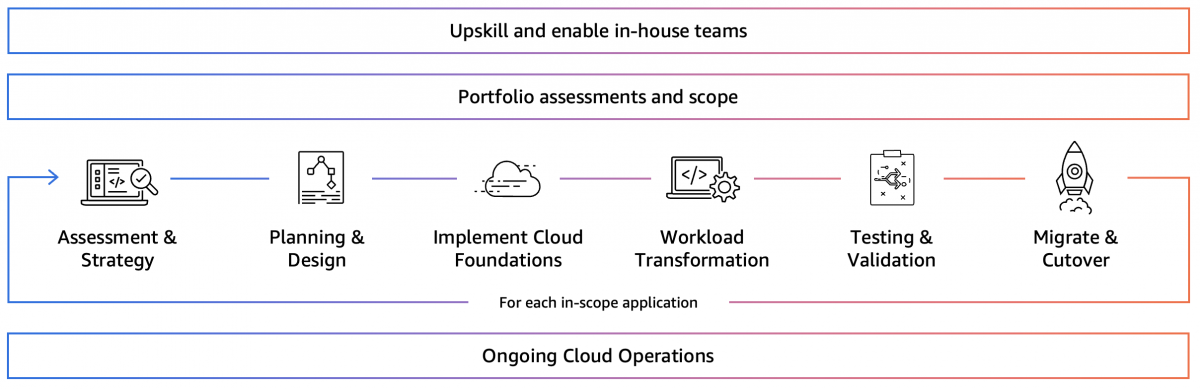
Modernizing mission-critical workloads is a multi-phase process that combines people, processes, and technology. A structured approach helps organizations reduce disruption while delivering incremental value throughout the journey.
Upskilling and Enabling Internal Teams
Technology alone does not drive modernization—people do. Internal teams must be able to design, build, deploy, and operate modern cloud-native solutions with confidence. Organizations are encouraged to invest in cloud skills early, ensuring that architects, developers, and operations teams understand AWS services, security models, and architectural best practices. AWS tools such as Learning Needs Analysis (LNA) help assess existing skills and identify targeted enablement paths. Softprom supports customers with training, enablement programs, and architectural guidance aligned with AWS frameworks.
Application Portfolio Assessment and Scope Definition
Modernization starts with understanding the application landscape. Enterprises typically manage large portfolios with complex dependencies, legacy technologies, and varying business criticality.
At this stage, organizations analyze:
- Application dependencies and shared services
- Business criticality and modernization drivers
- Technical debt and operational risks
Defining the right scope ensures focus on applications that deliver the highest business impact while keeping modernization aligned with strategic objectives.
Application Assessment and Modernization Strategy
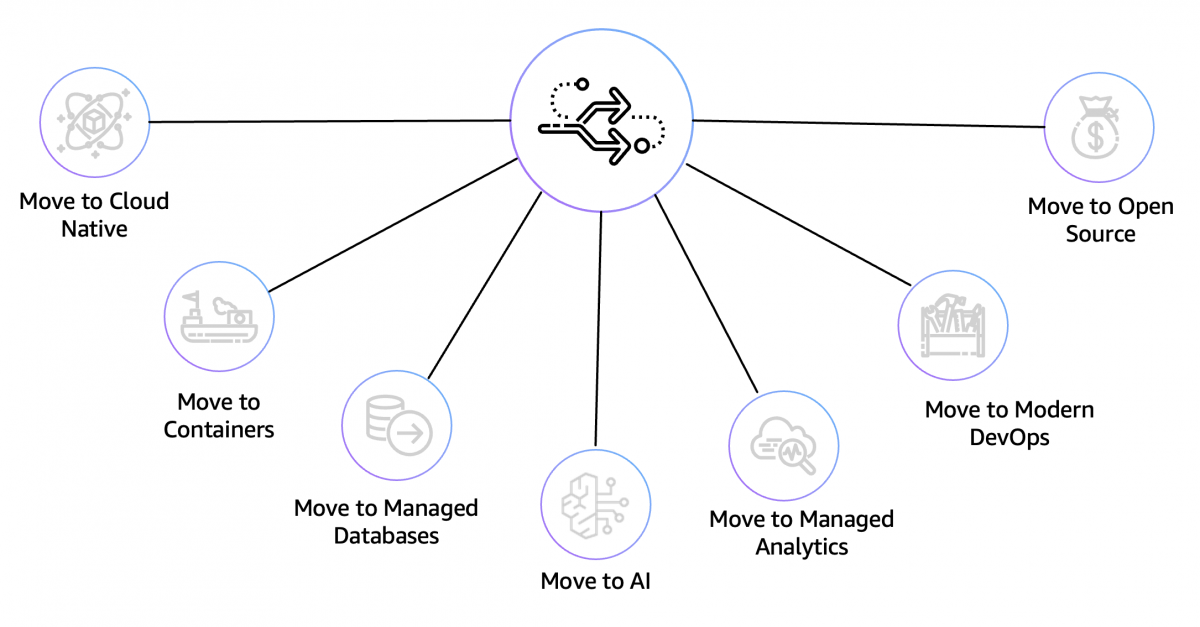
Once the scope is defined, each application or component requires a clear modernization strategy. AWS provides Modernization Pathways, such as:
- Moving to cloud-native architectures
- Adopting containers and managed Kubernetes
- Migrating to managed databases
- Modernizing DevOps practices
- Leveraging AI, analytics, and open-source technologies
The goal is not to modernize everything at once, but to define a directional strategy that aligns business priorities with technical feasibility. For example, legacy .NET workloads may be transformed toward open-source platforms using automated assessment and code analysis tools.
Planning and Architecture Design
During the planning and design phase, target architectures and implementation roadmaps are created for each in-scope application.
For custom or poorly documented systems, discovery and analysis tools help automatically identify dependencies, data flows, and modernization opportunities. An incremental modernization approach is strongly recommended—delivering value in stages rather than through large, high-risk transformations.
Typical examples include:
- Migrating databases to Amazon RDS
- Introducing CI/CD and modern DevOps practices
- Gradually transitioning to microservices architectures
Implementing AWS Foundations
For organizations new to AWS, establishing a secure and scalable cloud foundation is a critical prerequisite. This includes:
- Designing a multi-account AWS landing zone
- Implementing network connectivity and identity management
- Enforcing governance, compliance, and security controls
AWS solutions such as the Landing Zone Accelerator simplify this process and align environments with AWS Well-Architected and global compliance frameworks.
Softprom helps customers design and deploy cloud foundations suitable for regulated and mission-critical environments.
Workload Transformation and Modernization
The transformation phase focuses on implementing the target architectures and modernizing application components.
AI-powered development tools are increasingly accelerating this phase by automating code analysis, documentation, testing, and refactoring. Generative AI tools can convert high-level prompts into detailed technical specifications, working code, and test cases—dramatically reducing time and effort.
By combining automation with proven AWS services, organizations can modernize faster while maintaining quality and control.
Testing and Validation
Before production deployment, rigorous testing is essential. This typically includes:
- Functional and integration testing
- Performance and scalability testing
- Security and compliance validation
- Resilience and disaster recovery testing
AI-assisted testing tools, such as automated unit test generation, help reduce manual effort and improve coverage. For regulated environments, AWS security and assurance services support compliance with standards such as PCI DSS or HIPAA.
Migration and Cutover
The migration and cutover phase involves moving data and redirecting production traffic to the new AWS-based environment. Best practices include:
- Incremental or canary deployments
- Controlled traffic routing using DNS services
- Reliable data migration and synchronization
AWS services such as AWS Database Migration Service (DMS), AWS DataSync, and Amazon Route 53 help ensure smooth and predictable transitions with minimal downtime.
Ongoing Cloud Operations
After migration, workloads must be operated reliably and securely. This requires teams with AWS operational expertise and mature processes for monitoring, incident response, and optimization.
Organizations often run game days to simulate failure scenarios and validate operational readiness. Where internal capacity is limited, AWS Managed Services (AMS) can provide operational support, allowing teams to focus on innovation rather than day-to-day infrastructure management.
Conclusion
Modernizing mission-critical applications on AWS is a strategic journey, not a single event. By following a structured, end-to-end approach, organizations can minimize risk, reduce disruption, and unlock long-term business value.
Softprom, as an official Amazon Web Services Partner, helps customers plan, execute, and operate modernization initiatives—combining AWS best practices with deep regional and industry expertise.
Whether you are modernizing a single critical system or transforming an entire application portfolio, Softprom and AWS provide the tools, expertise, and services to accelerate your cloud journey with confidence.
Share:


