
Tasks
- Transition from simplified methods to deformation-based modeling.
- Predicting settlement and structural displacements.
- Analyzing weak, water-saturated, and heterogeneous soils.
- Modeling construction stages and consolidation.
- Increasing the accuracy and justification of engineering decisions.
- Integrating all factors to ensure reliable engineering solutions.
Results
- Accurate prediction of structural deformations.
- Project cost savings through design optimization.
- Ability to model staged construction.
- Improved communication with clients thanks to clear visualizations.
- Readiness for complex engineering projects with high safety requirements.
Description
Background for Implementing Plaxis 2D Ultimate at WESTHEM GROUP
Modern infrastructure construction requires not only verifying structural stability but also accurately predicting deformations, accounting for construction stages, and understanding the behavior of weak soils over time. In projects involving peat, silt, water-saturated or heterogeneous foundations, traditional calculation methods (Bishop, Fellenius, etc.) become insufficiently accurate.
WESTHEM GROUP, a Ukrainian engineering company and the exclusive representative of the German geosynthetics manufacturer HUESKER, works on extensive infrastructure, industrial, and hydraulic engineering projects where the cost of every mistake is exceptionally high. This is why the transition to deformation-based modeling became a strategic necessity.
WESTHEM GROUP specializes in complex projects: road embankments, transport interchanges, retaining walls, coastal protection, dams, municipal waste landfills, airfields, and other structures in challenging geological conditions that require geosynthetic materials and precise geotechnical calculations.
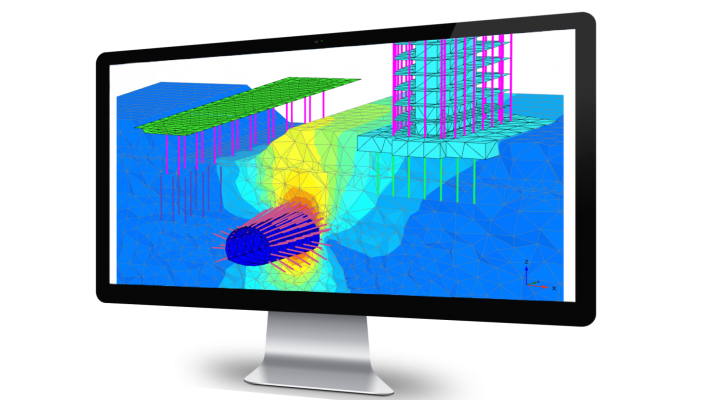
The company aimed to transition from basic analytical methods to modern finite-element analysis of stress-strain behavior (SSB) to simulate complex soil models and account for pore pressure and foundation behavior over time.
Key Challenges and Engineering Tasks
The company faced several critical technical challenges that traditional approaches could not solve:
- Need for deformation prediction: settlement of embankments on weak foundations, horizontal displacements of retaining walls, and long-term performance of structures.
- Complex geological conditions: heterogeneous soils, lenses, and water-saturated layers.
- Time-dependent behavior: consolidation and soil creep, which are critical for weak foundations.
- Hydraulic conditions: modeling filtration processes and pore water pressure.
- Limit equilibrium method limitations: it does not provide stress-strain information and cannot simulate staged construction.
“We needed a tool that would allow us to simulate the real behavior of soil, not just obtain a stability factor. For complex projects, that is not enough.”
Why WESTHEM GROUP Chose Plaxis 2D Ultimate
Plaxis 2D Ultimate proved to be the optimal solution for the company’s engineering needs for several reasons:
- Advanced soil models — Hardening Soil (HS), Soft Soil Creep (SSC), enabling simulation of nonlinearity, hardening, and creep.
- Accurate deformation prediction and the ability to evaluate real structural behavior over time.
- Staged construction modeling — essential for the design of high embankments.
- Consolidation analysis of water-saturated weak foundations.
- 2D configuration — optimal balance between accuracy and computational efficiency.
“The Ultimate version provides access to extended soil models and modules. For our projects, this is a necessity, not an option.”
Implementation Process and Initial Difficulties
Implementing Plaxis 2D Ultimate required restructuring technical processes and approaches to geotechnical modeling. The main challenges included:
- Learning FEM — requiring deep knowledge of soil mechanics.
- High-quality input data — the need for extensive laboratory soil testing.
- Model verification — comparing Plaxis results with field measurements and classical calculation methods.
“The most difficult part was entering the soil parameters correctly. But after calibrating the model, we began to obtain highly accurate and reliable results.”
Implementation Results
The transition to Plaxis 2D Ultimate provided WESTHEM GROUP with a new level of accuracy and efficiency:
- Accurate deformation analysis — a key advantage over limit equilibrium methods.
- Staged construction modeling — reducing risks already at the design stage.
- Scenario analysis — rapid evaluation of multiple structural alternatives.
- Improved communication with clients thanks to clear visualizations and easy-to-understand charts.
Project Example
During the design of a road embankment on a weak peat foundation, traditional methods indicated the need for a pile foundation. Modeling in Plaxis 2D Ultimate using the SSC model justified a more economical alternative — a reinforced embankment built in stages. This provided significant savings in both time and cost for the client.
“Plaxis enabled us to avoid expensive solutions where a more efficient, engineered approach was possible. The client saves money, and we gain confidence in the reliability of the structure.”
Collaboration with Softprom
The company chose Softprom as its distributor because of Bentley Systems’ official partner status, fast technical support, and the team’s expertise. Softprom engineers helped select the correct license configuration, set up the SES licensing system, and start work without delay.
“For us, it is important not just to buy software, but to have a partner who helps with technical questions and understands the specifics of the product. Softprom provided exactly this level of service.”
Recommendations
WESTHEM GROUP recommends that engineering organizations planning to adopt Plaxis should not cut costs on staff training or high-quality geological investigations. These factors directly determine the accuracy of the model and the success of the project. At Softprom, we also recommend turning to professionals who thoroughly understand Plaxis, can organize the implementation efficiently, and are ready to respond quickly to technical questions. This allows engineers to focus on solving complex challenges rather than searching for solutions themselves. By choosing Softprom, you gain a reliable partner who makes complexity simple and ensures your project's success.