


How Government Agencies Can Modernize Cybersecurity with Amazon Bedrock AgentCore
News | 02.03.2026
Transforming Government Cybersecurity Operations with Amazon Bedrock AgentCore
Government agencies face an escalating cybersecurity burden. Traditional SIEM platforms generate thousands of daily alerts, overwhelming SOC analysts who must manually triage and investigate incidents. Industry research indicates that up to 70% of alerts are false positives, leading to alert fatigue, delayed response times, and inconsistent analytical quality.
For public sector organizations dealing with sophisticated nation-state threats and strict regulatory frameworks, this reactive model is no longer sustainable.
As an official AWS partner, Softprom supports government institutions in deploying secure, scalable AI-driven security architectures. In this article, we explore how agencies can implement agentic AI for cybersecurity operations using:
- Amazon Bedrock AgentCore
- Amazon Web Services
The result is a structured, auditable, and intelligent threat detection and response framework aligned with public sector compliance requirements.
From Reactive Alerts to Proactive Intelligence
Traditional rule-based systems react to predefined patterns. Agentic AI systems, by contrast, can:
- Reason through complex multi-stage attack patterns
- Plan multi-step investigative workflows
- Execute automated remediation procedures
- Learn from historical threat data
- Collaborate across multiple AI agents
This shift enables agencies to transition from manual incident handling to structured, AI-assisted operations.
The Agent Graph Architecture for Government Security
Government operations demand predictable workflows, documented escalation paths, and strong auditability. The Agent Graph coordination pattern addresses these requirements by enforcing deterministic workflows while enabling intelligent analysis.
This model supports:
- Clear chains of custody
- Structured investigation processes
- Repeatable decision-making
- Documented escalation procedures
- Full audit traceability
It aligns with regulatory frameworks such as:
- National Institute of Standards and Technology (NIST)
- Federal Risk and Authorization Management Program (FedRAMP)
- Federal Information Security Modernization Act (FISMA)
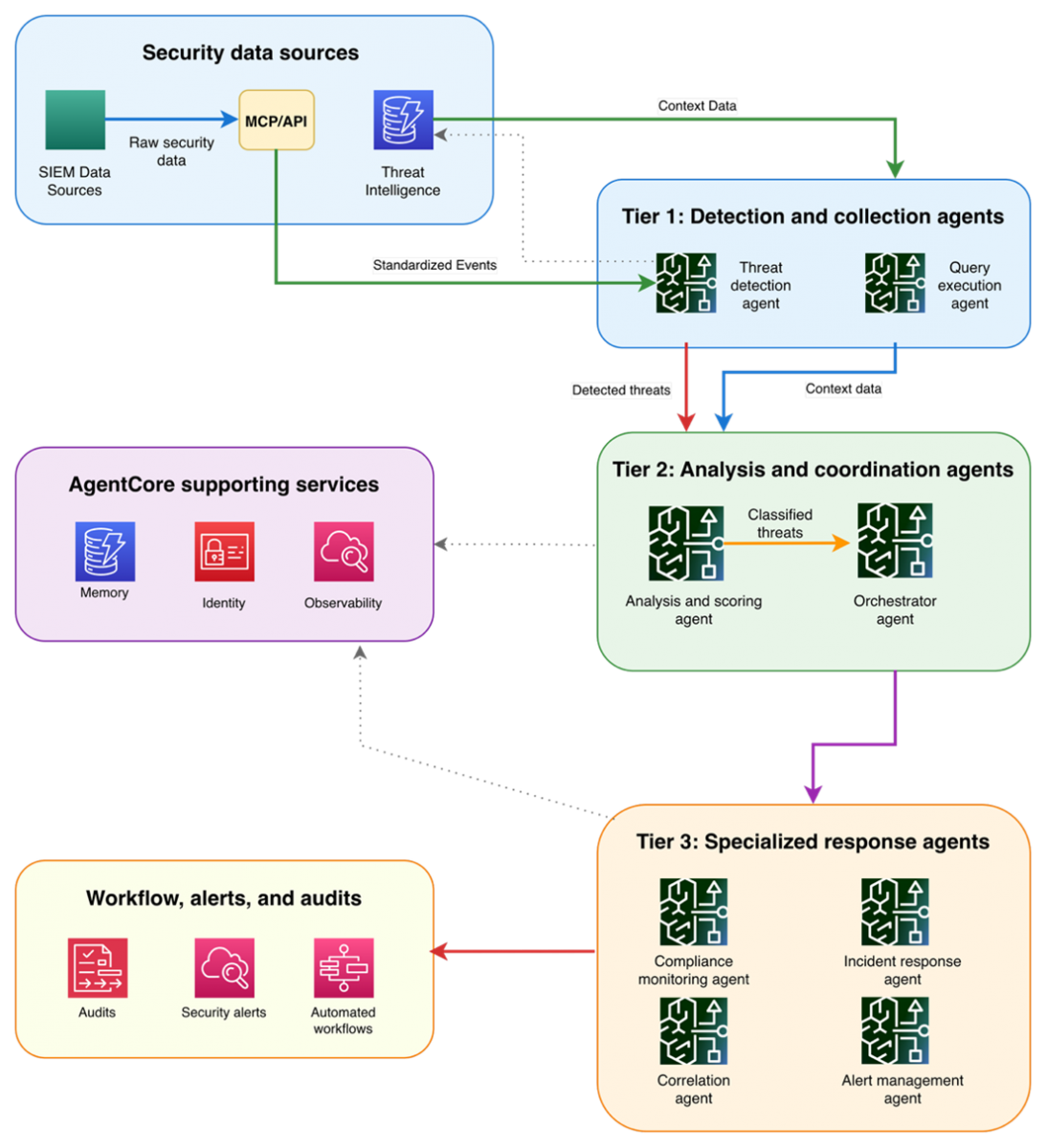
Three-Tier Multi-Agent Security Architecture
The proposed architecture mirrors government operational structures and clearance models.
Tier 1: Automated Threat Detection and Data Collection
Threat Detection Agent
Continuously monitors SIEM streams via the Model Context Protocol (MCP) or secure APIs. It identifies anomalies in real time and logs threats into intelligence databases.
Query Execution Agent
Retrieves contextual intelligence when suspicious activity is detected.
This tier acts as the sensor layer, filtering signal from noise.
Tier 2: Intelligent Analysis and Coordination
Analysis and Scoring Agent
Applies AI-driven classification to evaluate:
- Attack vectors
- Targeted systems
- Potential blast radius
- Alignment with known threat actor tactics
It generates standardized severity scores.
Orchestrator Agent
Routes threats through predefined response workflows based on classification and organizational policies. Every incident follows structured procedures while adapting to context.
This layer ensures both intelligence and compliance consistency.
Tier 3: Specialized Response Agents
Correlation Agent
Identifies relationships across seemingly unrelated events, detecting multi-stage or cross-environment attacks.
Incident Response Agent
Automates containment and remediation tasks while preserving approval checkpoints and documentation trails.
Compliance Monitoring Agent
Continuously verifies regulatory adherence and generates audit-ready documentation.
Alert Management Agent
Manages escalation protocols and ensures correct notification chains based on severity and hierarchy.
Together, these agents create a coordinated and controlled response ecosystem.
Implementing the Architecture with Amazon Bedrock AgentCore
Amazon Bedrock AgentCore provides the managed capabilities required for secure agent deployment at scale.
AgentCore Runtime
- Serverless hosting environment
- Isolated execution sessions
- Secure microVM architecture
- Built-in scalability
This ensures secure multi-agent operation suitable for government compliance requirements.
AgentCore Memory
Provides persistent contextual storage, allowing agents to:
- Reference past incidents
- Analyze historical threat patterns
- Maintain sovereign data controls
AgentCore Identity
Handles complex authentication requirements, including non-human identities (agents). It ensures secure access to AWS services and third-party systems.
AgentCore Observability
Integrated with Amazon CloudWatch and OpenTelemetry-compatible telemetry, it provides:
- Real-time activity monitoring
- Detailed audit trails
- Operational transparency
This observability layer supports regulatory oversight and accountability.
Measurable Outcomes for Government Agencies
An Agent Graph architecture powered by agentic AI can deliver:
- Reduced investigation time through structured coordination
- Improved threat detection accuracy
- Lower false positive rates via intelligent scoring
- Built-in compliance documentation
- Faster and more consistent incident response
Most importantly, it enables agencies to shift from reactive operations to proactive security intelligence while preserving transparency and governance.
Conclusion
Agentic AI represents a strategic opportunity for government agencies to modernize cybersecurity operations without compromising compliance or accountability. By implementing a structured multi-agent architecture using Amazon Bedrock AgentCore on AWS, public sector organizations can:
- Enhance detection and response capabilities
- Maintain deterministic, auditable workflows
- Reduce operational overhead
- Strengthen regulatory compliance
As an AWS partner, Softprom helps government institutions assess their current SIEM environments, design phased implementation strategies, and deploy secure AI-driven cybersecurity frameworks tailored to public sector requirements.
The future of government cybersecurity lies in intelligent automation—structured, transparent, and built for scale.
Share:


