


AWS Digital Sovereignty Well-Architected Lens: A Practical Framework for Sovereign-Ready Cloud Architectures
News | 10.02.2026
Amazon Web Services Introduces the Digital Sovereignty Well-Architected Lens to Support Compliance-Ready Cloud Workloads
As organizations accelerate cloud adoption, digital sovereignty has become a critical requirement for building trust with customers, regulators, and partners worldwide. The challenge today is no longer whether to move to the cloud, but how to adopt cloud technologies while meeting sovereignty, compliance, and regulatory obligations across different jurisdictions.
While sovereignty requirements vary by region, most organizations address them through a consistent set of technical and operational controls, applied at scale. These controls typically cover:
- Data residency and data protection
- Privacy and access control
- Operational resilience and auditability
They also align with established regulatory and security frameworks such as EU GDPR, EU DORA, German BSI C5, UK GDPR, and emerging regulations including the EU AI Act.
To help customers systematically address these requirements, AWS has introduced the AWS Digital Sovereignty Well-Architected Lens.
What Is the AWS Digital Sovereignty Well-Architected Lens?
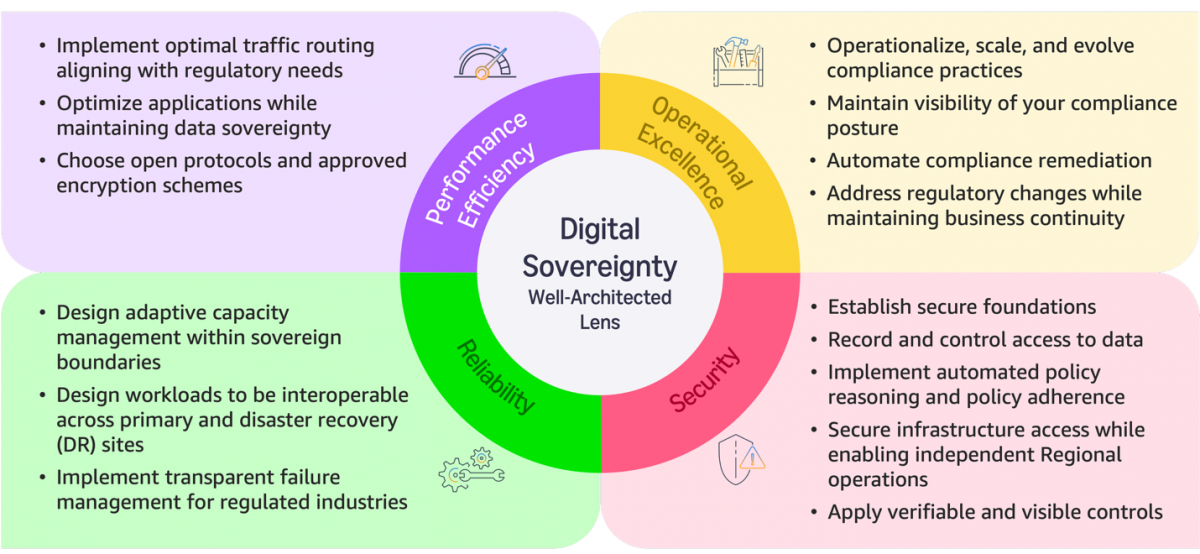
The Digital Sovereignty Well-Architected Lens is a specialized extension of the AWS Well-Architected Framework. It provides structured guidance to help organizations design, build, and operate workloads that are sovereign, compliant, auditable, interoperable, and portable, while maintaining high levels of performance and resilience.
The lens is available as:
- A dedicated AWS whitepaper
- A custom lens file from the AWS Well-Architected custom lens GitHub repository
As an official AWS Partner, Softprom helps customers apply this lens in real-world cloud projects, ensuring sovereignty requirements are addressed from architecture design through day-to-day operations.
How the Lens Fits into the AWS Well-Architected Framework
The AWS Well-Architected Framework is built around six pillars:
- Operational Excellence
- Security Reliability
- Performance Efficiency
- Cost Optimization
- Sustainability
The Digital Sovereignty Lens complements this framework by adding sovereignty-focused questions and best practices across four pillars:
- Operational Excellence
- Security
- Reliability
- Performance Efficiency
Cost Optimization and Sustainability are addressed using existing AWS Well-Architected best practices.
In total, the lens defines more than 60 best practices, each framed as a question such as “How do you design your workload for continuous auditability?”, followed by actionable guidance and implementation steps.
Core Design Principles for Digital Sovereignty
At the foundation of the Digital Sovereignty Lens are five key design principles, building on “secure by design” and “privacy by design” concepts:
1. Apply Standardized, Enforceable Controls
Organizations are encouraged to replace manual processes with policy-as-code and compliance-as-code approaches. Automated controls reduce ambiguity and ensure consistent enforcement across teams and environments.
2. Align Security Controls with Data Sensitivity
Security mechanisms—including access control, encryption, and data perimeters—should be calibrated to the sensitivity and sovereignty requirements of the data, such as residency or export restrictions.
3. Design for Continuous Compliance
Compliance should not be treated as a point-in-time exercise. By embedding compliance checks into the software development lifecycle, organizations remain audit-ready and reduce long-term risk.
4. Design for Interoperability and Portability
Workloads should be designed with standard interfaces and abstractions, enabling portability across environments and reducing dependency on specific infrastructure components.
5. Design for Survivability
Sovereign workloads must remain resilient. This includes documenting dependencies, defining recovery objectives, testing failover paths, and ensuring data sovereignty is preserved during recovery scenarios.
Who Benefits from the Digital Sovereignty Lens?
The lens is designed for a wide range of stakeholders, including:
- Policy-makers and regulators developing sovereignty models
- CxOs and enterprise architects shaping long-term cloud strategies
- Security and compliance consultants translating regulatory requirements into controls
- Application builders and engineers designing sovereign-ready workloads
- Audit professionals validating evidence and controls
- GRC teams managing risk profiles across applications
Softprom works with these stakeholders to translate the framework into practical, implementable AWS architectures.
Building Sovereign-Ready Workloads with AWS and Softprom
The Digital Sovereignty Lens is part of a broader AWS initiative to provide customers with tools, reference frameworks, and architectural guidance for sovereignty-driven cloud adoption.
This includes resources such as the AWS European Sovereign Cloud – Sovereign Reference Framework (ESC-SRF), available via AWS Artifact, which customers and partners can use as a foundation for audit and compliance documentation.
In parallel, AWS continues to introduce new capabilities that increase transparency, control, and trust, including enhancements in identity and access management, isolation, governance automation, and infrastructure configuration.
As an official AWS Partner, Softprom supports organizations at every stage of this journey—from sovereignty assessment and architecture design to implementation, compliance alignment, and operational governance.
Conclusion
The AWS Digital Sovereignty Well-Architected Lens provides a clear, structured, and actionable approach to addressing sovereignty requirements in the cloud. By embedding compliance, security, resilience, and portability into workload design, organizations can confidently scale cloud adoption while meeting regulatory expectations.
With AWS technologies and Softprom’s regional expertise, customers can move beyond theoretical compliance and build sovereign-ready, audit-ready, and future-proof cloud architectures.
Share:


